I almost cried in a stadium full of strangers.
I was at a concert in LA, surrounded by tens of thousands of fans — most of them not Korean, most of them probably unable to order food in Korean — and they were all singing Arirang. A 600-year-old Korean folk song. A sad one. And as the sound rolled across the stadium, I thought about independence fighters I’d learned about in school a lifetime ago, and one quiet sentence formed in my head: we kept this alive, and here it is, living, on the other side of the world.
Let me tell you what this song actually is. Once you know, you’ll understand why a Korean guy nearly lost it in a crowd of strangers.
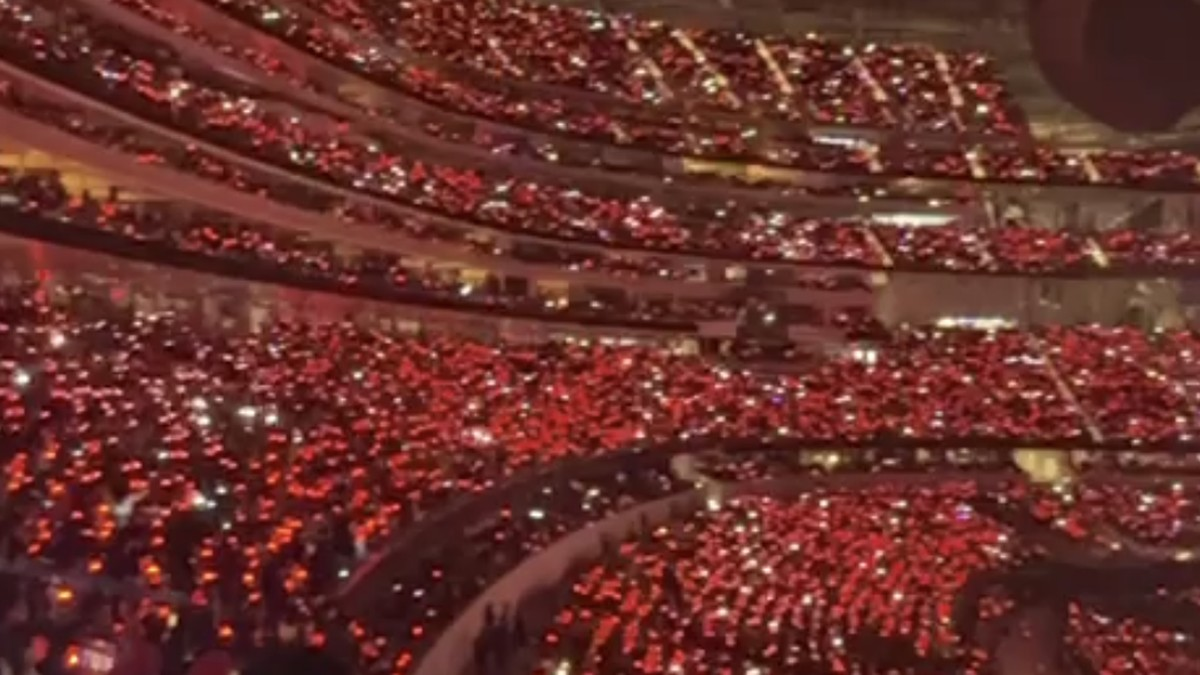
I didn’t catch Arirang on camera — I was too busy trying not to cry. But this is what that stadium looked like that night.
What Is Arirang?
Arirang is Korea’s most recognized piece of music — and nobody knows exactly where it came from. It’s at least 600 years old. There are over 3,000 versions of the lyrics and around 50 different melodies, scattered across every region of Korea. Its origin is genuinely lost to history, which somehow makes it feel less like a song someone wrote and more like something the country simply grew.
It’s not the official national anthem. But it functions like one — sung at ceremonies, in films, at reunions. In 2012 UNESCO added it to the list of humanity’s intangible cultural heritage. Then North Korea added its own version in 2014. Think about that: a divided peninsula that agrees on almost nothing, and both halves reached for the same song.
Why It Sounds So Sad: The Untranslatable Word
Here’s the part that doesn’t fully cross into English. The emotion Arirang carries has a name — han (한, 恨) — and there’s no clean English word for it.
Han isn’t just sadness. Western grief tends to move toward closure; you process it, you heal, you move on. Han doesn’t resolve. It’s a mixture of sorrow, longing, quiet resentment, and endurance that settles into the body and stays — coexisting with ordinary life without ever fully lifting. It’s the emotional residue of a people who endured centuries of hardship and learned to carry it rather than shed it.
Arirang is the sound of han set to melody. That’s why it can feel heavy even to someone who doesn’t understand a single word — the feeling is in the notes, not just the lyrics.
What the Words Actually Say
The most famous version is deceptively simple. A person watches someone they love walk away over a mountain pass, and half-curses, half-pleads: may your feet grow sore before you get far.
That mountain pass — the gogae — matters. Korea’s landscape is ridges and valleys, villages divided by mountains. To leave meant to climb a pass and vanish from sight, suddenly and completely, in a way flat land never forces. So the pass became the natural image for every painful goodbye. Arirang is, at its core, a song about watching someone disappear — and the specific geography that made disappearing feel so final.
The Song That Refused to Die
This is where it stops being just a love song.
During the Japanese occupation of Korea (1910–1945), Arirang became an act of resistance — a coded expression of Korean identity at a time when that identity was being actively erased. At points it was banned outright. People sang it anyway.
And they kept singing it everywhere history scattered them. Farmers sang it in mountain terraces. Political prisoners sang it in colonial jails. Korean soldiers sang it on both sides of the 1950 war. Korean immigrants sang it in places their children would grow up calling home — from Los Angeles to Kazakhstan — people who had never set foot in the country their grandparents left, holding a melody as the last thread back to it.
That’s the lineage I was hearing in that stadium. Not a pop moment. A 600-year relay.
Why BTS Named an Album After It
If you’ve read my piece on Kim Gu, you can see where this is going. Kim Gu, the independence leader, dreamed of a Korea made powerful not through military might but through culture. When BTS titled their album Arirang, they reached past the charts, past K-pop itself, all the way back to that dream — invoking the love, the sorrow, and the sheer resilience the song has always carried, and reaffirming exactly where they come from.
It’s a bold choice. Arirang isn’t a flashy, streamable word to slap on a global release — it’s a 600-year-old ache. Naming the album after it tells you BTS wasn’t chasing a trend. They were planting a flag in their own history.
So when a BTS stadium in LA sings Arirang, it isn’t just fan service. It’s the oldest Korean song arriving at a destination its earliest singers could never have imagined.
Oppa’s Last Word
I grew up learning about the people who kept this song — and this country — alive through occupation, war, and exile. Names in a textbook, distant and heavy. I never expected to feel their presence in an American stadium, in a crowd that mostly couldn’t read the word “Arirang.”
But that’s what got me. All that sorrow, all that endurance, carried across six centuries by people who refused to let it die — and here it was, alive, sung by fifty thousand voices who simply loved it. We kept it alive. And it made it all the way here.
I didn’t cry. But it was close. And now you know why.
P.S. My wife — the real ARMY in our house — was the one who dragged me to this concert. I thought I was there for her. Turns out it was for me too.
Leave a Reply