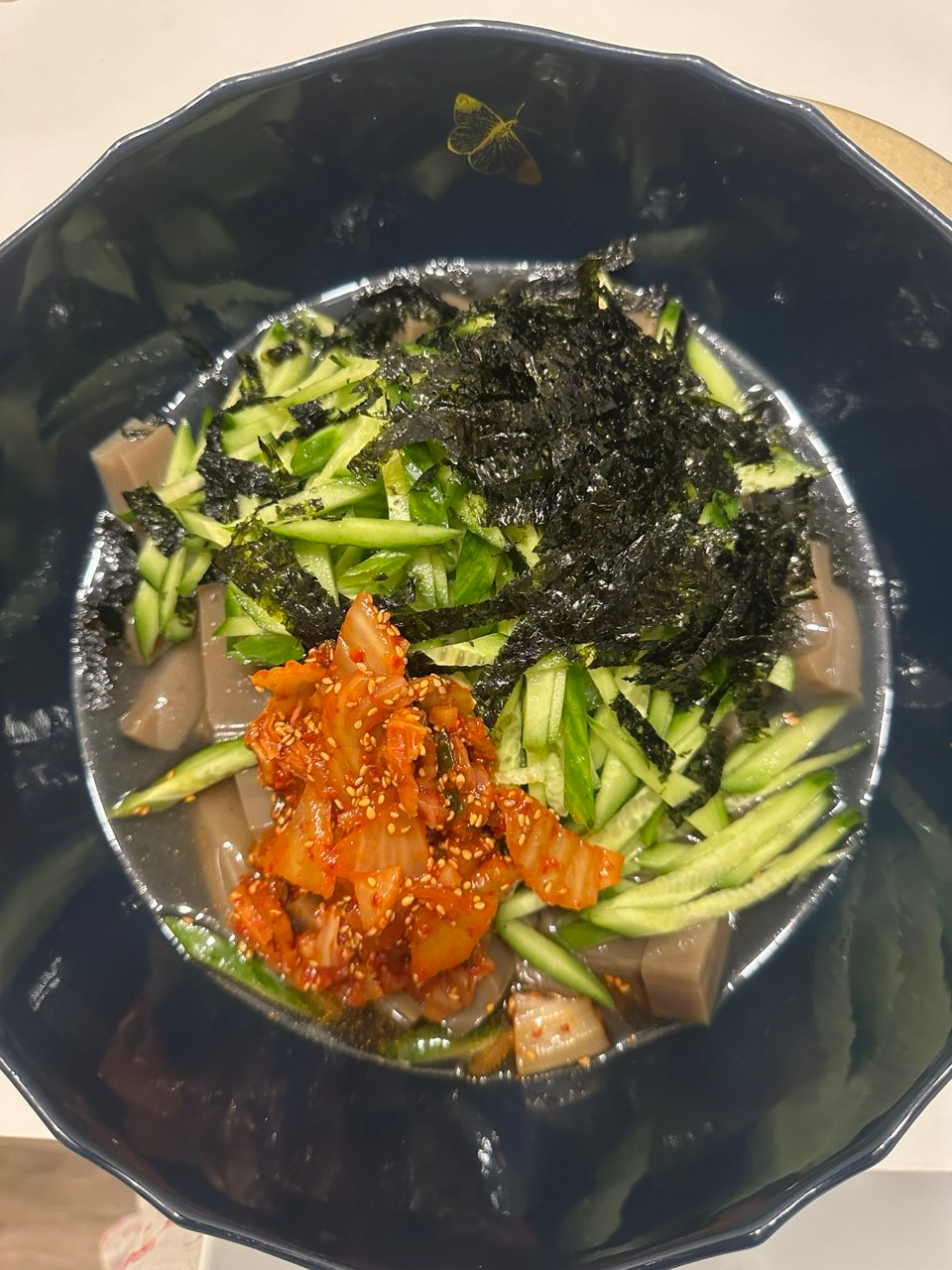
Let me guess your first reaction: acorns? Like, squirrel food?
Yes. Koreans took the nut you rake off your lawn every fall, figured out how to turn it into food centuries ago, and never looked back. The result is dotori-muk (도토리묵) — acorn jelly — and the dish I want to introduce today is muk-sabal (묵사발): chilled acorn jelly in a savory broth. My wife made it last week, I inhaled the whole bowl, and then I realized most of my non-Korean friends have never even heard of it. Let’s fix that.
First, the Texture — Because Your Brain Will Glitch
Muk has the texture of a soft pudding or a delicate panna cotta. It jiggles. It’s smooth. It slides off the spoon. Your brain sees it and files it under dessert.
Then you taste it: zero sweetness. None. It’s earthy, clean, almost neutral, with a faint nuttiness somewhere in the background. Sweet texture, savory soul — and once your brain accepts the contradiction, you’re hooked. The muk itself is a canvas; the flavor comes from everything around it.
Wait, Can You Even Eat Acorns?
Not raw, no — and this is where it gets interesting. Acorns are packed with tannins, the same bitter compounds in over-steeped tea, and your body can’t properly digest them straight off the tree. The squirrels can keep those.
So Koreans engineered a fix, centuries ago: grind the acorns, soak them in water, let everything settle, pour off the water, repeat — again and again — until the bitterness is washed out and what’s left is clean starch. Cook that starch with water, let it cool, and it sets into that silky brown jelly. All that washing is exactly why good muk tastes smooth and clean instead of bitter and gritty.
(Modern shortcut: Korean markets sell pre-processed acorn starch powder. Mix, boil, chill, done. Our ancestors did the hard part so we don’t have to.)

From Survival Food to Delicacy
Here’s the part I love. Dotori-muk wasn’t invented as a delicacy — it was born in Korea’s mountain regions, where oak trees dumped free calories on the ground every autumn and people were resourceful enough to use them. It keeps well, so travelers packed it for long journeys. During the Joseon Dynasty, it even fed a king and his court while they took refuge in the mountains during war.
A food that started as “what we eat to survive” is now something my wife makes because it’s delicious and I write love letters to it on the internet. Not a bad glow-up for squirrel food.
Muk-sabal: The Dish Itself
Muk-sabal literally means “a bowl of muk.” Slices of acorn jelly in a chilled savory broth, topped with kimchi, cucumber, toasted sesame, and crushed gim (seaweed). You eat it like a cold noodle soup — except instead of noodles, silky jelly pieces slide through the broth.
It’s a summer dish at heart: cold, light, refreshing. It’s also a beloved companion to makgeolli (Korean rice wine) on a drinking night — light enough to keep eating, savory enough to keep the drinks honest.
The Diet Food Korea Actually Eats
Korean grandmas and gym trainers rarely agree on anything, but they agree on muk. Acorn jelly is mostly water — roughly 40–50 calories per 100 grams, a fraction of what rice or noodles bring. It’s also naturally gluten-free and vegan, with no fat, cholesterol, or sodium of its own.
I won’t promise it melts fat — no food does that. But a big, cold, genuinely satisfying bowl that barely registers on the calorie count? That’s why it’s one of Korea’s go-to diet foods, and why nobody eating it feels like they’re on a diet.
How to Try It in the LA Area
Route 1 — Assemble at home (what we do). Korean markets sell fresh dotori-muk in the refrigerated section — it looks like a block of dark brown tofu. Hannam Chain in LA Koreatown and H Mart in Buena Park both carry it, usually near the tofu and fresh noodles. Slice it, pour chilled broth over it, top with kimchi, cucumber, and sesame. Ten minutes, no cooking.
Route 2 — Order it out. Restaurants with traditional or old-school menus sometimes serve muk-muchim (the salad version) or muk-sabal — especially makgeolli specialists. Ask for it. The surprised, delighted look you’ll get for knowing this dish is worth the trip on its own.
Oppa’s Last Word
There’s a whole category of Korean food that never makes it onto the “10 Korean Dishes You Must Try” lists — too humble, too hard to explain, no cheese pull for the camera. Muk-sabal is the king of that category. It’s what Koreans actually eat at home on a hot day, and now you know it exists.
Next time you’re at H Mart, look for the jiggly brown block near the tofu. Trust the block.