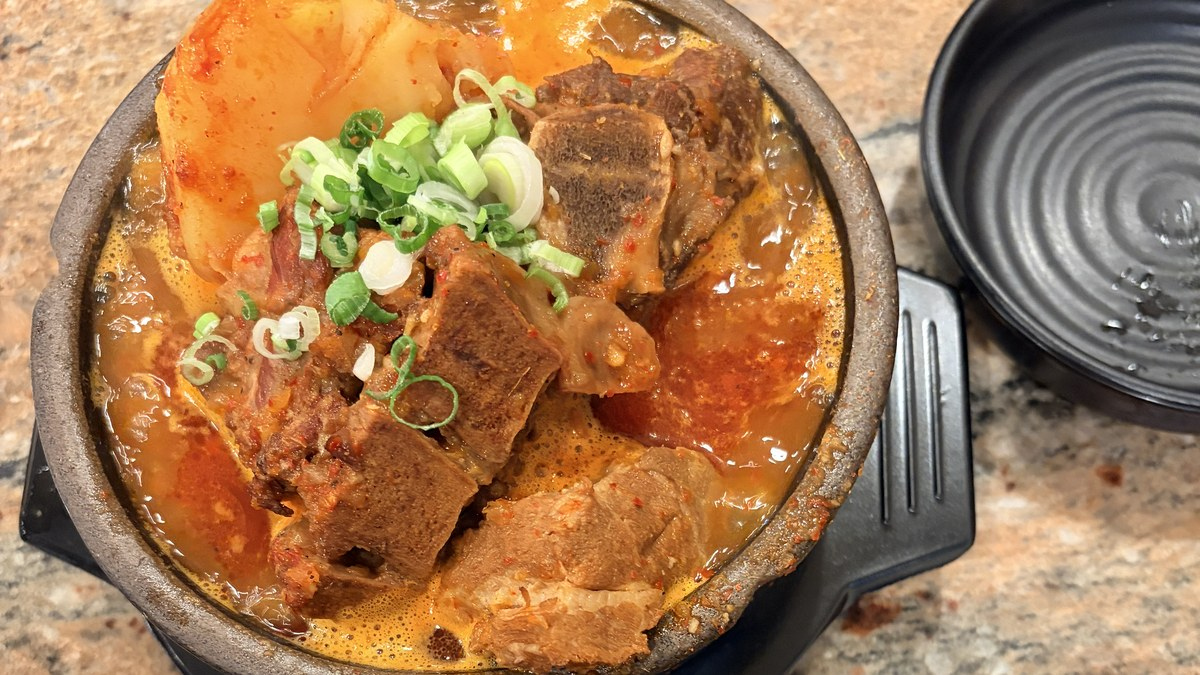
There’s a bowl of soup I eat by myself, on purpose, more often than I’d like to admit.
It arrives still boiling in a black stone pot. The broth is red and a little oily on top. Half the bowl is giant chunks of pork bone, the meat practically falling off. And somewhere in there is a potato the size of my fist.
This is gamjatang (감자탕), Korean pork bone soup. If you’ve never had it, this is your sign.
What Is Gamjatang?
At its simplest, gamjatang is pork spine (or neck bones) simmered for hours until the meat goes tender and the broth turns rich. Then it gets the full Korean treatment: red pepper paste, garlic, perilla seed powder for a nutty depth, dried napa cabbage leaves, green onion, and a few big chunks of potato.
It tastes deep, spicy, and a little earthy, like a stew that’s been working on itself all day. Because it has.

You eat it with your hands as much as your spoon. Pick up a bone, work the meat off with your chopsticks (or just your fingers, nobody’s judging), and drop the clean bone in the empty bowl they give you for exactly that. There will be a pile. That’s how you know you did it right.
Wait, Is “Gamja” Really Potato?
Here’s the fun part. Gamja (감자) is the Korean word for potato, so gamjatang should just mean “potato soup.” Simple, right?
Ask a few Koreans, though, and you’ll hear a different story: that “gamja” is actually an old butcher’s term for a part of the pork spine, and the potato just showed up later and took the credit.
It’s a great story. I’ve told it at dinner myself. But honestly? Linguists haven’t found much proof for it, and the more boring answer is probably the right one: it’s called potato soup because there’s potato in it.
Either way, the potato is not the point. The bones are.
Why I Eat It Alone
In Korea, gamjatang usually comes in a huge shared pot, the kind you put in the middle of the table for three or four friends after work, maybe with a bottle of soju. At the end, the staff stir rice and seaweed into whatever broth is left and fry it right in the pot.
That’s a great night. But the single-serving version, one stone pot, one bowl of rice, a few side dishes, is my weekday comfort food.
Koreans even have a word for eating alone: honbap (혼밥), short for “honja bap,” meal by yourself. For a long time, eating solo at a Korean restaurant felt a little awkward, like everyone could tell you had no friends. That’s changed a lot. Now honbap is just normal, and a hot bowl of soup is one of the most honbap-friendly meals there is. You don’t need to share, you don’t need to talk, and you definitely don’t need to look graceful while you’re fighting a pork bone.
Where I Go: Jang Ga Nae, Rowland Heights
My regular spot is Jang Ga Nae (장가네), a small family-style Korean restaurant in Rowland Heights. It’s tucked inside an office building, the kind of place you’d walk right past if you didn’t know it was there.
A single order runs about $20, and it comes with rice and side dishes. On my last visit that meant kimchi and stir-fried fish cake. The portion is big. I’ve never left hungry.
What keeps me coming back is the broth. It’s rich without being heavy, spicy without burning your mouth, and it tastes like home. The meat comes off the bone easily, and nobody looks twice at a guy eating by himself.
I don’t always go alone, though. When I bring my wife, she finishes every last drop of the broth, which in a Korean restaurant is about the highest compliment you can give. Bowls don’t come back that empty unless the soup is really good.
Jang Ga Nae
1722 Desire Ave #108, Rowland Heights, CA 91748
Check hours before you go. Like a lot of small family places, they take breaks and aren’t open every day.
Tips for Your First Gamjatang
- Use the empty bowl. That’s your bone bowl. Don’t leave bones floating in the soup.
- Don’t fear the bones. Pick them up. It’s the only way to get the best meat, tucked in between the vertebrae.
- Ask about spice. It’s usually medium-spicy. If you’re sensitive, ask, and keep the rice close.
- Eat the potato last. By then it’s soaked up all that broth. Trust me.
- Going with friends? Order the big shared pot and save room for the fried rice at the end.
Oppa’s Last Word
Some meals are about the people at the table. Gamjatang can be one of those, a big pot, loud friends, a fried-rice finale.
But sometimes the best company is a boiling stone pot, a pile of bones, and nobody asking you anything for twenty minutes. If you’re in the San Gabriel Valley and need that kind of lunch, you know where I’ll be.
Leave a Reply