Two women in my phone call me oppa. One of them is my sister. The other is a friend who isn’t related to me at all. Neither of them is flirting with me.
If that surprises you, you’ve probably learned the word from K-dramas, where “oppa” usually comes out in a soft, sing-song voice right before someone falls in love. That’s not wrong. But it’s maybe a quarter of the story.
This blog is called LA Oppa, so I figured I owed you the full explanation.
What Oppa Actually Means
Literally, oppa (오빠) means “older brother” — but only when a woman is saying it.
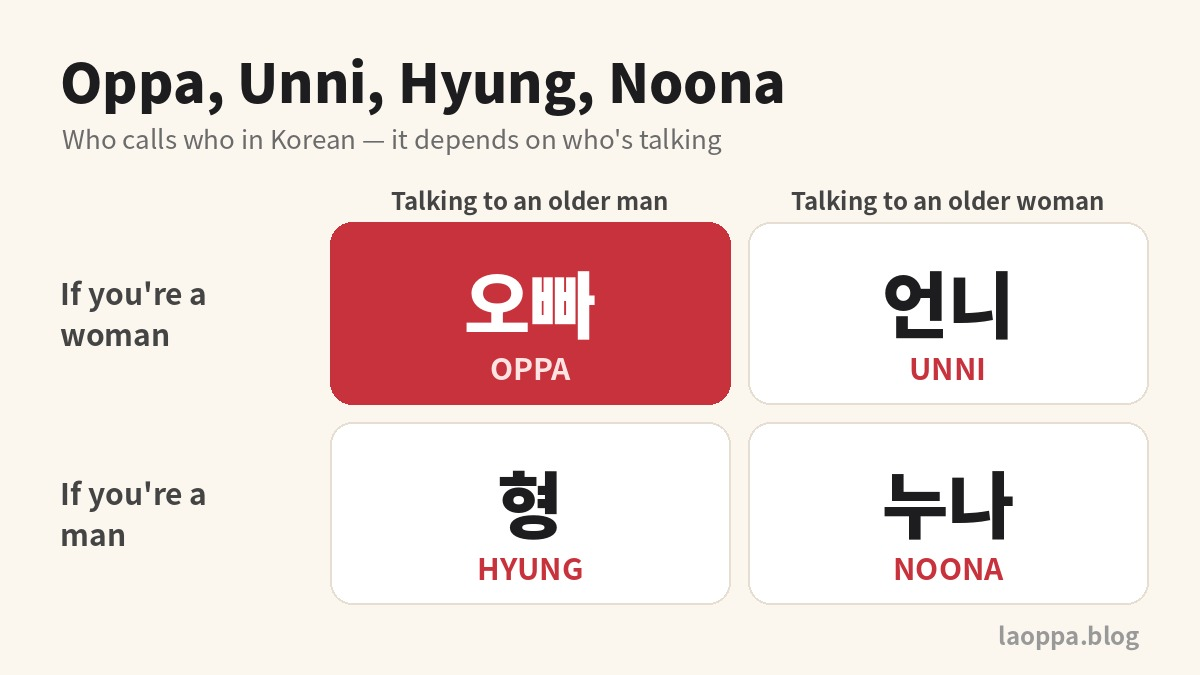
That’s the part most people miss. Korean doesn’t have one word for “older brother.” It has two, and which one you use depends on whether you’re a man or a woman. The same goes for “older sister.” So there are four words, and the whole system looks like this:
- A woman calls an older man oppa (오빠)
- A woman calls an older woman unni (언니)
- A man calls an older man hyung (형)
- A man calls an older woman noona (누나)
So when my sister calls me oppa, that’s the dictionary definition in action. When a guy my age calls me something, it’s hyung — never oppa. A man saying “oppa” sounds about as odd in Korean as a grown man calling his friend “Mommy” in English.
Same Word, Two Very Different Relationships
Here’s where it gets interesting. Koreans don’t save these words for family. We use them for almost anyone slightly older who we’re close to — friends, coworkers, the older kid in your church youth group, the guy who runs your favorite restaurant.
Here’s proof, straight from my phone:

On the left is my actual sister, reminding me that our mom’s birthday is this Sunday, just in case I forgot. (Korean sisters: the family calendar you never asked for.) On the right is a younger friend wishing me a happy birthday, complete with a strawberry cake sticker.
One is family. One isn’t. Both say oppa. Neither is romantic.
Why Age Matters So Much in Korea
To understand why these words are everywhere, you need to know one thing about Korean culture: age decides how you talk to someone.
Korean has different levels of politeness built right into the grammar. You speak one way to someone older, another way to someone younger, and yet another way to a stranger. Before you can even pick your verb endings, you need to know who’s older.
That’s why one of the first questions Koreans ask each other is “How old are you?” It isn’t nosy. It’s practical. Once you know, the relationship snaps into place — and so does what you call each other.
Using someone’s first name alone, if they’re older than you, can feel cold or even rude. Calling them oppa or unni does the opposite: it says we’re close, and I respect you. It turns a stranger into a kind of chosen family.
So Why Does It Sound So Romantic?
Because it also works that way.
In Korea, a woman usually calls her boyfriend oppa if he’s older — which he often is. Plenty of Korean wives keep calling their husbands oppa long after the wedding. So the word carries warmth, closeness, and yes, sometimes romance.
K-dramas lean hard into that last part. The shy “oppa…” moment has become a famous trope, and tone does a lot of the work. Said flatly, it’s just a name. Said sweetly, with a little aegyo (Korean-style cuteness), it’s something else entirely.
The word didn’t change. The voice did.
Can Non-Koreans Say Oppa?
Absolutely — and millions already do. K-pop fans all over the world call their favorite idols oppa, the way Korean fans have for decades. If you’ve ever heard a stadium full of ARMY scream it, you know. (If you’re curious what that stadium actually feels like, I wrote about it in my Arirang piece.)
A few friendly tips if you want to use it right:
- Only women say oppa. If you’re a guy, the word you want is hyung. Listen to how BTS’s youngest member talks to the others — it’s hyung all day long.
- Only for someone older than you. Calling a younger man oppa just sounds confused.
- Watch the tone. With a Korean friend, oppa is sweet and warm. With a Korean man you just met, a very sugary oppa might send a message you didn’t mean to send.
And you’ll hear it in a song you already know: “Oppan Gangnam Style” literally means “Oppa is Gangnam style.” PSY was bragging about himself, from the point of view of the women he imagined admiring him. Now the joke makes a lot more sense.
Oppa’s Last Word
When I named this blog LA Oppa, I wasn’t trying to sound like a K-drama lead. (My sister would never let me live that down.)
I picked it because of what oppa means at its heart: the older one who looks out for you. The one who’s been around a little longer, who shows you where the good barbecue is, who explains why a 600-year-old song makes grown men choke up, and who doesn’t mind when you ask the same question twice.
That’s what I try to be here — your Korean older brother in LA. So whatever you’re curious about, ask away. That’s what oppas are for.
Leave a Reply